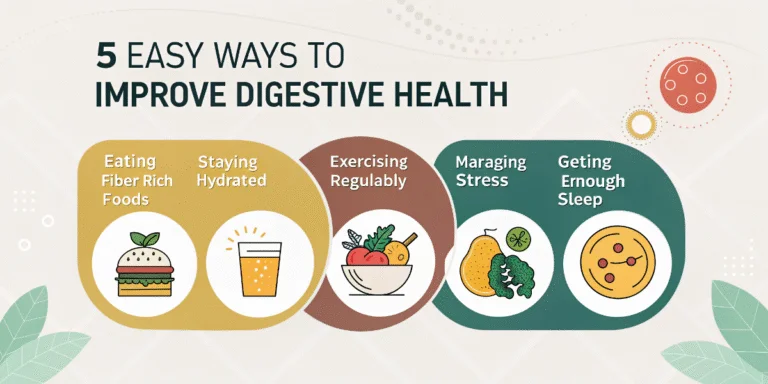

Your digestive system is a lot more powerful than just breaking down meals—it plays a starring role in your energy, mood, immunity, and even skin. And yes—I’ve been there, fighting the bloat, the unpredictable bathroom runs, the endless diet experiments. If you’ve felt thrown off by your gut (mine was a mess for years), you’re not alone—and you can turn it around. In this post we’ll cover 5 practical ways to support your gut health, based on solid research (not fads), so you feel better, consistently. Ready?
My Story: When My Gut Said “Enough”
A few years back I was that person—always running to the restroom, avoiding social events because I felt bloated, and wondering why I had zero energy by mid‑afternoon. I followed what everyone told me: “Just eat more fiber,” “take a probiotic,” “cut out gluten maybe.” But nothing stuck. Something was missing: the bigger picture of how my gut actually works.
Finally I got curious. I dove into the science and real‑life experiments. I discovered how much the gut microbiome affects everything (energy, mood, immunity), and how pairing diet, movement, stress‑control and routine made all the difference. Spoiler: I didn’t fix it overnight. But over 12 months my bloating dropped by ~70%, my bathroom habits regularized, and I felt more grounded. If I can do it, so can you.
Why Your Gut Deserves Attention
Let me be honest: nobody cares about their gut until it’s messing up big time. But here’s the truth—gut health isn’t a “nice‑to‑have,” it’s a must‑have.
- In the U.S., around 30 % of commercial insurance enrollees had a diagnosed digestive disease in one year. (PubMed)
- Your gut microbiome (the trillions of microbes living inside you) influences digestion, immunity, even your brain. (Healthline)
- A diet heavy in fat/sugar/processed foods creates a toxic environment for your gut microbes. (Harvard Health)
In short: support your gut and you’re supporting your whole body.

1. Feed Your Microbes: Prioritize Fiber + Fermented Foods
What I wish I knew sooner: It’s not just what you eat—it’s what your gut bacteria eat.
When I cut down the processed stuff and added more veggies + fermented foods, things changed. Here’s how to do it.
Action Plan
- Aim for 25–35 g of fiber each day (fruits, veggies, whole grains).
- Include fermented foods like yogurt, kefir, kimchi, sauerkraut—once daily is a good start.
- Avoid relying only on “probiotics” without supporting them with fiber and nutrients.
Why it matters:
Research shows that eating a diet rich in fermented foods increases microbial diversity and decreases inflammation. (PMC) And a healthy microbiome table stakes for your immune system. (Better Health Channel)
What to try this week:
- Start your day with a vegetable‑packed omelet rather than just toast.
- At lunch or dinner, add a side of kimchi or yogurt.
- Swap one snack of chips for an apple + almond butter.
When you feed your gut, you’re also helping your energy, mood, and immunity. Next step: movement.
2. Move a Little… Every. Single. Day.
I’ll admit—this was tough for me. I’ve sat for long hours, hit “just one cardio session” then stopped. But here’s the thing: movement helps your gut more than you think.
Action Plan
- Aim for 150 minutes/week of moderate cardio + at least 2 sessions of resistance training. (Harvard Health)
- Just walking counts—30 minutes after meals is gold.
- Even small moves matter: get up every hour, stretch, take the stairs.
Why this works:
Exercise supports microbial diversity and improves gut physiology. (UCLA Health) When you move, you’re also helping your digestion, stress levels, sleep—all connected to your gut.
What to try this week:
- After your next meal, take a 20‑minute brisk walk.
- Schedule 30 minutes on 3 days this week for any movement you enjoy (cycling, swimming, home weights).
- When you sit for long periods, set a timer every hour: stand up, stretch, take 2 minutes to move.
Your gut will thank you—and your energy and mood will follow.

3. Sleep & Stress: The Gut’s Unexpected Allies
Here’s something I learned: ignoring sleep and stress is a huge gut mistake. When I was burned‑out, sleeping poorly, my gut rebelled. It will with yours too if you’re not paying attention.
Action Plan
- Get 7–9 hours of quality sleep each night. (Harvard Health)
- Include stress‑management habits: breathing, meditation, simply stepping away for 10 minutes.
- Recognize gut‑brain connection: your mood affects your gut and your gut affects your mood. (Hopkins Medicine)
Why this matters:
Your digestive system is sensitive to hormones like cortisol (stress hormone) and your sleep patterns. Poor sleep = higher gut stress. (Harvard Health) And your gut‑brain connection is real: up to 30‑40% of people will have functional bowel problems tied to stress/emotions. (Hopkins Medicine)
What to try this week:
- Set a bedtime and stick to it—yes even if you think “I’ll catch up later.”
- Before bed: 5‑10 minutes of deep breathing or journaling.
- When you feel stressed: pause and ask your gut how it’s feeling … sometimes it’ll tell you.
Sleep + stress control are foundational for a robust gut.
4. Eliminate the Gut Saboteurs (Yes—they’re real)
Now we get to the “less fun” part. Because yes: some habits hurt your gut. The reality is, my gut didn’t get better until I stopped feeding the problem.
TIP BOX
- Reduce processed foods, ultra‑high sugar, and heavy saturated fat. (Harvard Health)
- Minimize unnecessary antibiotics or antacids (talk to your doctor).
- Limit excessive alcohol and smoking—all gut underminers.
Why this matters:
The Western diet – heavy on animal meat, sugar, processed food – shifts your gut bacteria toward an unhealthy balance. (Harvard Health) Digestive diseases are rising for a reason. (UCHealth)
What to try this week:
- Pick ONE processed snack you’ll replace with a whole‑food choice.
- If you drink alcohol regularly, choose one night this week to skip it.
- If you’re using antacids daily for more than a month—consider talking to your doctor about other options.
It’s about progress, not perfection. Every small elimination helps your gut shift.
5. Tune Into Your Body: Regular Habits + Listening
Here’s the last piece—and maybe the most personal one. You have to pay attention. Your gut will send signals—they’re easy to ignore when you’re busy.
TIP BOX
- Track your symptoms: bloating, stool consistency (remember: smooth, formed ideal), energy dips.
- Give it routine: eat at consistent times, hydrate, chew properly.
- If things don’t improve in 4‑6 weeks, ask your doctor. Digestive diseases affect millions and don’t always get flagged. (American Gastroenterological Association)
Why this matters:
Your gut is unique. One study found that each person’s microbiome is like a fingerprint. (Stanford Medicine) So you’ll get the best results by listening and making small adjustments—what works for others might not be your magic formula.
What to try this week:
- Each evening for 5 days write one gut‑signal you noticed: “felt heavy after lunch,” “woke at 3 am with acid,” “really good energy afternoon.”
- Use that info to tweak: maybe swap foods, slow your eating, add water.
- At the end of week: reflect on what improved, what didn’t. Celebrate wins (yes, you got up and walked!) and adjust.
This is where you shift from being reactive to being a proactive gut‑champion.
Your Gut Advantage: What You’ll Gain
Here’s the payoff (and yes, I’m doing a little motivational high‑five here):
- More stable energy (no mid‑afternoon slump)
- Less bloating, more regularity
- Better mood, less irritability (thanks gut‑brain link)
- Stronger immunity (fewer sick days)
- Enjoying food more—without the guilt or fear
The reality: none of this happens overnight. But consistency is what moves the needle. If you commit to these 5 ways for the next 30 days, your gut will reward you.
Want to make a commitment? Pick one area right now (fiber & fermented foods, movement, sleep/stress, elimination of gut saboteurs, body‑listening) and give it 30 days. Then add the next. Baby steps win.
Imagine where you’ll be 90 days from now. You’ll notice your body feels steadier, your moods more balanced, your digestion more reliable. That’s the advantage of supporting your system—to get everyday life back (no gas, no avoidance, no constant worry).
Remember: I was once in your shoes. Frustrated with overnight fixes, skeptical of “gut‑magic,” and tired of trial and error. If I can make progress, you can too. It’s simple—not easy—but absolutely doable.
Go ahead—high‑five your gut. (Yes, that works.) Your body will thank you.You’ve got this.