Last updated: July 12, 2026
The optimal nap length during a night shift is between 10 and 90 minutes, depending on your schedule and goals. For a quick alertness boost with minimal grogginess, a 10-20 minute power nap is best. For deeper recovery during a longer break, a 30-60 minute nap works well, but be prepared for some sleep inertia. A 90-minute nap allows for a full sleep cycle, maximizing restoration and cognitive benefits, making it ideal for very long shifts.
Key Takeaways
- 10-20 Minute Power Nap: Best for a rapid boost in alertness and performance with minimal grogginess upon waking. Ideal for safety-critical jobs.
- 30-60 Minute Nap: Offers better fatigue recovery but comes with a higher risk of “sleep inertia,” or grogginess, that can last for up to 30 minutes [5].
- 90 Minute Nap: Allows for one complete sleep cycle, including deep and REM sleep, which significantly improves memory and cognitive function [3]. Best for extended 12+ hour shifts.
- Split Naps: For extremely long shifts (16+ hours), a split strategy of a 90-minute nap early in the shift and a 30-minute nap later can be highly effective [2].
- Pre-Shift Nap: Taking a 30-minute nap before your shift begins can help build a “sleep reserve” and reduce fatigue from the start [6].
- Timing is Everything: Napping earlier in your shift is generally better to avoid disrupting your main sleep period after work.
- Consistency Matters: For permanent night workers, maintaining a consistent 7-9 hour daytime sleep schedule, even on off days, is crucial for long-term health [7].
Fighting off drowsiness when the world around you is asleep is one of the biggest challenges for any night shift worker. Whether you’re a nurse monitoring patients, a truck driver on a long haul, or a factory worker overseeing machinery, staying alert is non-negotiable. The key isn’t just surviving the night; it’s about thriving. This raises a critical question for millions of workers: how long to nap during night shift for the best results? The answer isn’t one-size-fits-all. The ideal nap, from a 10-minute power-up to a full 90-minute cycle, depends entirely on your shift length, your role, and when you can take a break.
How Long Should You Nap During a Night Shift?
The best nap duration during a night shift depends on how much time you have and your goal. A 10-20 minute “power nap” is ideal for a quick energy boost without grogginess. A 30-60 minute nap provides deeper rest but may cause temporary grogginess. A 90-minute nap completes a full sleep cycle, offering the most significant cognitive restoration.
Choosing the right nap length is a strategic decision to combat fatigue. Your body moves through different sleep stages, and waking up during the wrong one can leave you feeling worse than before. Understanding the trade-offs between nap length and the potential for sleep inertia, that groggy, disoriented feeling upon waking, is key to making your break work for you.
The Best Nap Lengths for Night Shift Workers
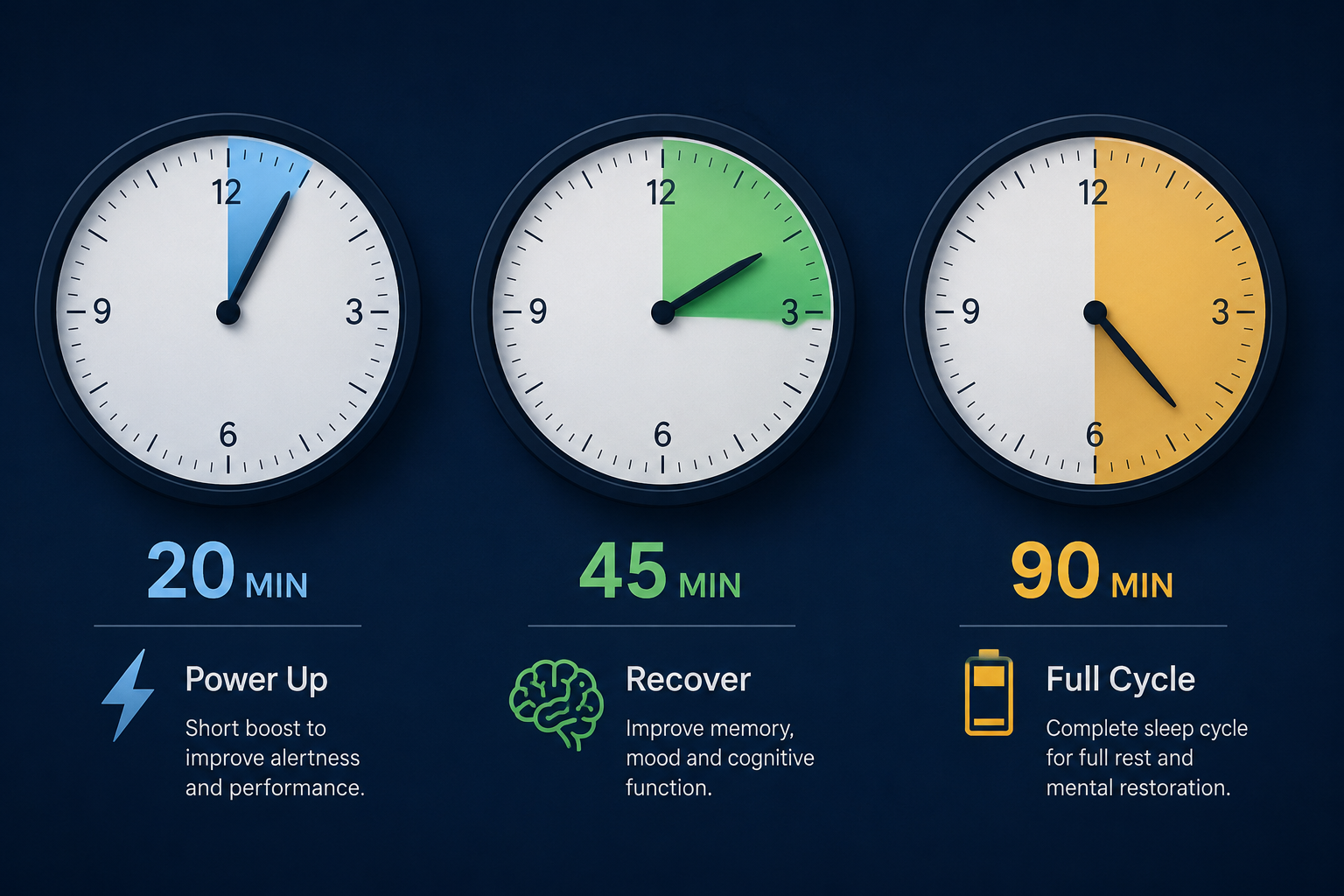
The three most effective nap strategies for night shift workers are the 10-20 minute power nap, the 30-60 minute recovery nap, and the 90-minute full-cycle nap. Each serves a different purpose in your fight against fatigue.
10-20 Minute Power Nap
A short power nap of 10 to 20 minutes is your best bet for a fast and effective boost in alertness. This duration keeps you in the lighter stages of sleep, allowing you to wake up easily and get back to work without significant grogginess.
- Benefits: Increases alertness, improves motor performance, and enhances focus.
- When to use it: Perfect for short breaks or when you need to be sharp immediately after waking. Research shows 10-minute naps taken between 4:00 and 5:00 a.m. produce minimal sleep inertia, making them ideal for workers in safety-critical roles [8].
- Avoiding Grogginess: Keeping the nap under 20 minutes is the best way to prevent entering deep sleep, which is the primary cause of sleep inertia.
30-60 Minute Nap
This medium-length nap allows for some slow-wave (deep) sleep, which is excellent for physical and mental recovery. However, this comes with a significant trade-off: a higher likelihood of sleep inertia.
- Deeper Recovery Benefits: Helps clear adenosine, a chemical in the brain that promotes sleepiness, leading to a more substantial reduction in fatigue.
- Why Sleep Inertia Can Happen: Waking up after 30-60 minutes often interrupts deep sleep [4]. This can cause significant grogginess that may take 15-30 minutes to shake off, though performance improvements follow [8, 5].
- When This Nap Works Best: Ideal if you have a longer break and can afford a 15-30 minute “recovery” period after waking up before you need to perform critical tasks. The CDC suggests a 30-minute nap can be effective for standard 8-hour shifts [1].
90 Minute Nap
A 90-minute nap is often considered the gold standard for on-shift rest because it allows for one complete sleep cycle. This includes light sleep, deep sleep, and REM (dream) sleep.
- Completing a Full Sleep Cycle: Waking up at the end of a cycle, as you return to a lighter stage of sleep, drastically reduces sleep inertia and maximizes cognitive benefits like memory consolidation and creative problem-solving [3].
- Best for Long Shifts: This is the most restorative option and is highly recommended for workers on extended shifts of 12 hours or more, or for those who are significantly sleep-deprived [1]. A 2023 study even found a split-nap strategy (a 90-minute nap followed by a 30-minute one later) was optimal for a 16-hour shift [2].
When Is the Best Time to Nap During a Night Shift?
The best time to nap is either before your shift starts to build up a sleep reserve or during the first half of your shift to combat early fatigue. Napping too late in your shift can interfere with your ability to get quality sleep when you get home.
- Before Your Shift: Taking a 30-minute nap about 1.5 to 3 hours before you leave for work is a proven strategy to improve alertness from the moment you clock in [6].
- During a Work Break: Napping during a designated break is the most common strategy. Aim for the “midnight-to-dawn” window when your body’s drive for sleep is strongest. This is when your circadian rhythm hits its lowest point, making a nap most effective.
- After Getting Home: This isn’t a “nap” but your main sleep period. It’s crucial to prioritize a consistent 7-9 hour block of sleep during the day to truly recover [7]. Check out our science-backed strategies for sleeping better after a night shift for more tips.
How Long Should Nurses Nap During Night Shift?
For nurses on a 12-hour shift, a longer nap of 2 to 3 hours is more effective at fighting fatigue than shorter naps [1]. However, if only a short break is possible, a 20-minute power nap is the best option to maintain alertness without post-nap grogginess.
Hospital environments are demanding, and fatigue can have serious consequences. For a standard 8-hour nursing shift, a single 30-minute nap is recommended by the CDC to maintain energy [1]. During intense 12-hour shifts, which are common in healthcare, a 90-minute nap can be a game-changer if policies and staffing allow for it. It provides the deep, restorative sleep needed to stay sharp for the entire shift.
How Long Should Truck Drivers Nap During Night Shift?
Truck drivers should prioritize a 10-20 minute power nap to quickly restore alertness for safe driving. Waking from a short nap minimizes sleep inertia, which is critical when you need to be in full control of a vehicle immediately.
For commercial drivers, managing fatigue is a matter of public safety. A pre-drive nap before the shift begins is a powerful preventative tool. If drowsiness hits mid-route, pulling over for a 20-minute power nap is far safer than pushing through. Longer naps (30+ minutes) should only be taken during mandated rest periods when there’s ample time to fully wake up before getting back on the road.
The Best Nap Schedule for Different Night Shift Workers
An effective nap schedule depends on your specific job and shift hours. The key is to schedule naps during your natural circadian low point (typically between 2 a.m. and 6 a.m.) to maximize their restorative effect.
Here are a few examples:
- 7 PM – 7 AM Healthcare Worker: A 90-minute nap around 2 a.m. is ideal if a long break is available. If not, a 20-minute power nap around 3 a.m. can help you push through the final hours.
- 11 PM – 7 AM Factory Worker: A 30-minute nap during a midnight or 1 a.m. lunch break can help reset your energy for the second half of the shift.
- Overnight Security Guard: During long, quiet periods, a 20-minute power nap can be a useful tool to maintain vigilance. Setting an alarm is crucial.
- On-Call Emergency Worker: Naps are unpredictable. The goal should be to take 20-minute power naps whenever a window of opportunity arises to bank rest before a call comes in.
For more information on sleep science, explore our sleep data insights.

How to Wake Up Without Feeling Groggy After a Night Shift Nap
The best way to wake up without feeling groggy is to give yourself a 10-15 minute buffer before returning to work. Use this time to expose yourself to bright light, hydrate, and move your body to signal to your brain that it’s time to be alert.
- Light Exposure: Bright light is the most powerful signal to your brain to wake up. Spend a few minutes in a well-lit area.
- Hydration: Drink a full glass of cold water immediately after your alarm goes off. Dehydration can mimic feelings of fatigue.
- Caffeine Timing: Try a “caffeine nap.” Drink a cup of coffee right before you take a 20-minute nap. The caffeine will take about 20-30 minutes to kick in, so you’ll wake up feeling the combined benefits of the rest and the stimulant.
- Movement: Do some simple stretches, walk around for a few minutes, or even do a few jumping jacks to get your blood flowing and shake off the sleepiness.
Common Night Shift Napping Mistakes to Avoid
The most common napping mistake is napping for too long without a buffer period, leading to severe sleep inertia. Other mistakes include napping too close to your main sleep period and creating a poor sleep environment.
- Napping Too Long (Unintentionally): A 20-minute nap that turns into a 60-minute one can leave you feeling worse if you wake from deep sleep. Always set an alarm.
- Napping Too Close to “Bedtime”: Taking a long nap in the final hour or two of your shift can make it difficult to fall asleep for your main sleep period when you get home.
- Using Caffeine Incorrectly: Drinking caffeine to power through the end of a shift and then trying to sleep an hour later is a recipe for poor rest. Limit caffeine to the first half of your shift.
- Ignoring Your Sleep Environment: Even a short nap is more effective in a cool, dark, and quiet space. Use an eye mask, earplugs, or a white noise app to block out distractions.
Frequently Asked Questions
Is a 20 minute nap enough for a night shift?
Yes, a 20-minute power nap is highly effective for boosting alertness and cognitive performance for 1-3 hours with minimal grogginess, making it one of the best options for night shift workers.
Is a 2 hour nap before a night shift good?
A 2-hour nap before a night shift can be very beneficial, as it allows you to get through a full 90-minute sleep cycle plus some extra rest. It helps reduce sleep debt and can significantly improve your performance and mood throughout the shift.
Should I nap before or during a night shift?
Both are effective strategies. A nap before a night shift helps you start with more energy. A nap during the shift helps you combat fatigue that builds up over the long hours. If your schedule allows, doing both can be an excellent strategy for managing 12+ hour shifts.
How much sleep do night shift workers need?
Night shift workers need the same amount of sleep as day workers: 7-9 hours per 24-hour period. The challenge is achieving this quality and quantity of sleep during the daytime when your body’s circadian rhythm is promoting wakefulness.
Can naps replace nighttime sleep?
No, naps are a supplement, not a replacement, for a full period of restorative sleep. They are a powerful tool for managing fatigue during a shift, but you must still prioritize getting a consolidated 7-9 hour block of sleep each day.
Conclusion
Figuring out how long to nap during a night shift is a personal science. While research provides excellent guidelines, the perfect nap is the one that works for your body and your job.
To recap the best practices:
- For a quick boost: Stick to a 10-20 minute power nap.
- For deeper recovery (with time to wake up): A 30-60 minute nap can work.
- For maximum restoration on long shifts: Aim for a 90-minute nap to complete a full sleep cycle.
Experiment with different nap lengths and timings to see what leaves you feeling the most refreshed. Pay attention to your body, prioritize your main sleep period, and use strategic napping as your secret weapon to conquer the night shift and protect your health.